Performance
This page documents the write, read, and startup performance of node-event-storage at scale and explains how to tune the two main parameters that control it.
Benchmarks were captured on Node.js v20 with the default configuration (matcherProperties: ['stream', 'payload.type'], maxOpenPartitions: 1024). Each document is ~108 bytes. Write samples are averaged over 100 consecutive write() calls with all secondary indexes registered. Read samples are averaged over 100 reads spread evenly through the primary index.
Scenario A — 1 index per partition (growing partitions)
Each partition holds 20 documents. The number of secondary indexes equals the number of partitions.
| Partitions | Startup (ms) | Write (ms/op) | Read (ms/op) |
|---|---|---|---|
| 100 | 7.1 | 0.076 | 0.061 |
| 1 000 | 43.4 | 0.059 | 0.023 |
| 5 000 | 177.9 | 0.087 | 0.024 |
| 10 000 | 355.5 | 0.404 | 0.025 |
| 20 000 | 871.4 | 0.352 | 0.031 |
Scenario B — 100 fixed partitions, growing index count
The partition count is fixed at 100. The document set grows proportionally so each index receives at least 20 documents.
| Indexes | Startup (ms) | Write (ms/op) | Read (ms/op) |
|---|---|---|---|
| 100 | 2.9 | 0.030 | 0.022 |
| 1 000 | 22.1 | 0.034 | 0.022 |
| 5 000 | 246.2 | 0.049 | 0.057 |
Analysis
Write latency
Write latency is kept near-constant across both dimensions by the discriminant lookup table (see Tuning: matcherProperties below). Instead of testing every registered matcher on every write() call (O(N) scan), the store does a two-level Map lookup on the document's discriminant property and only evaluates the one or two indexes that actually match.
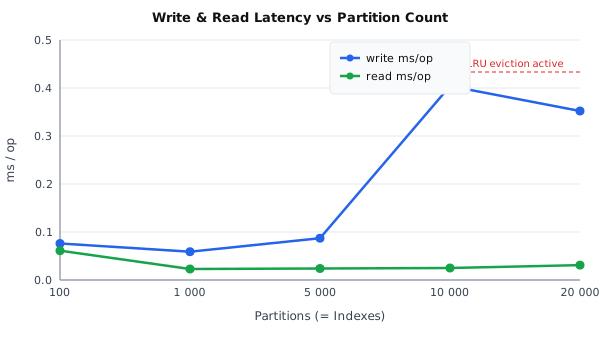
The visible spike at 10 000 and 20 000 partitions in Scenario A (0.40–0.35 ms) is caused by LRU partition-pool eviction. When the number of live partitions exceeds maxOpenPartitions (default 1 024) the store must close and reopen a file descriptor on every write that touches a cold partition. Below that threshold write latency stays flat at ≤ 0.09 ms regardless of how many total indexes are registered. See Tuning: maxOpenPartitions for guidance on eliminating this spike.
Read latency
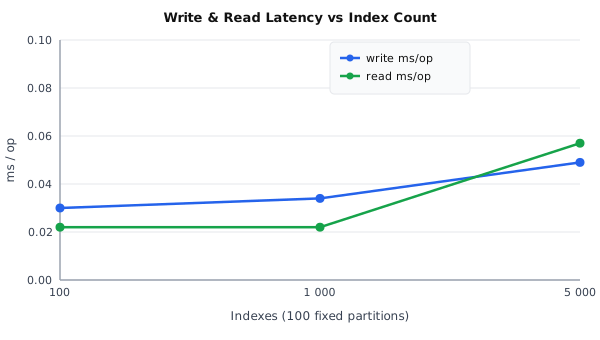
Read latency is dominated by the per-document partition seek and is largely flat in Scenario A because reads are served from the OS page cache after the first pass. The jump at 5 000 indexes in Scenario B (0.057 ms) reflects the larger document set per partition (1 000 docs/partition vs. 20) rather than the index count itself.
Startup time
Startup time scales linearly with the number of files on disk:
- The store performs one
readdircall over the data directory followed by oneopenper partition. - Registering secondary indexes (
openIndex/ensureIndex) costs oneopen+ header-read per index file.
For large deployments consider lazy-loading secondary indexes on first access rather than opening all of them during startup.
Tuning
matcherProperties
matcherProperties controls which document properties are used to build the fast O(1) discriminant table. The default value ['stream', 'payload.type'] covers the standard EventStore workload where each stream maps to exactly one secondary index matched by a { stream: '<name>' } object.
// Default — optimises for stream-keyed indexes
new Storage('events', { matcherProperties: ['stream', 'payload.type'] });

// Override when your documents use a different discriminant field
new Storage('events', { matcherProperties: ['tenantId', 'eventType'] });

// Disable — falls back to an O(N) scan (pre-v1 behaviour)
new Storage('events', { matcherProperties: [] });
At index registration the store inspects the matcher object and stores the index name in a two-level Map keyed by the first matcherProperties entry whose value is a scalar in the matcher. On write() the store extracts the same property from the incoming document and looks up only the matching index names — one Map lookup and one matches() call instead of N.
Function matchers and object matchers that do not contain any matcherProperties key are placed in an unclassified set and are always evaluated (they contribute an O(M) term where M is their count, independent of the total index count).
maxOpenPartitions
maxOpenPartitions caps the number of simultaneously open partition file descriptors. The default is 1 024. When a write() or read() needs a partition whose file descriptor has been evicted, the store closes the LRU entry and reopens the requested one.
| Scenario | Recommendation |
|---|---|
Partition count ≤ maxOpenPartitions |
Default is fine; all partitions stay open and write latency is flat. |
Partition count slightly above maxOpenPartitions, all partitions accessed frequently |
Raise maxOpenPartitions to cover the full partition count, or set it to 0 to disable eviction entirely. |
| Very large partition count (tens of thousands), access is skewed to a working set | Leave the default; the LRU naturally keeps the hot partitions open. |
| Memory or fd budget is tight | Lower maxOpenPartitions. Each open partition costs one fd and the OS typically needs ~8 KB of kernel memory per open file. |
// Raise the cap to avoid LRU eviction when all partitions are active
new Storage('events', {
    maxOpenPartitions: 4096
});

// Disable the cap entirely (pre-v1 behaviour — one fd per partition, forever)
new Storage('events', {
    maxOpenPartitions: 0
});
Note
At 10 000 partitions with the default cap of 1 024, every write touches a different partition in the sample, so every write triggers a close+reopen. Setting maxOpenPartitions to 0 (or ≥ 10 000) reduces write latency at that scale from ~0.40 ms back to ~0.09 ms.
Raw mode benchmarks
These benchmarks measure pure read operations (no writes). The range scan reads the middle third of the log.
| Scenario | Variant | Events/sec | Deviation | Runs |
|---|---|---|---|---|
| forward full scan | stable | 452,500 | ±0.83% | 60 |
| forward full scan | latest | 411,800 | ±1.25% | 55 |
| forward full scan | latest(raw) | 877,300 | ±0.83% | 75 |
| --- | --- | ---: | ---: | ---: |
| backwards full scan | stable | 421,000 | ±0.56% | 56 |
| backwards full scan | latest | 421,400 | ±0.32% | 56 |
| backwards full scan | latest(raw) | 871,600 | ±0.66% | 75 |
| --- | --- | ---: | ---: | ---: |
| join stream | stable | 424,500 | ±0.35% | 56 |
| join stream | latest | 396,500 | ±0.43% | 53 |
| join stream | latest(raw) | 798,000 | ±0.77% | 69 |
| --- | --- | ---: | ---: | ---: |
| range scan | stable | 453,288 | ±0.28% | 86 |
| range scan | latest | 423,291 | ±0.45% | 81 |
| range scan | latest(raw) | 886,578 | ±0.59% | 90 |
Raw Buffer Operator Matcher Benchmark
This benchmark compares the same matcher definitions in two execution modes:
obj(baseline): runmatches(document, matcher)on already deserialized eventsraw: runbuildRawBufferMatcher(matcher)directly on NDJSON buffers
Matcher objects used in bench/bench-matcher.js:
{ type: 'Foo' }
{ payload: { type: 'Foo' } }
{ payload: { type: ['BazingaHappened', 'Foo'] } }
{ payload: { type: ['BazingaHappened', 'BarxingaHappened', 'QuuxingaHappened', 'Foo'] } }
{ payload: { value: { $gt: 100 } } }
{ payload: { type: { $eq: 'Foo' } } }
{ payload: { value: { $gte: 100, $lt: 2000 } } }
{ payload: { value: { $gte: 100, $lt: 2000 }, type: 'Foo' } }
Observed median delta (raw vs obj) from the benchmark run:
At ANY match ratio, raw is roughly 40–55% slower than object mode. At ANY match ratio, raw is roughly 50–60% faster than object mode when deserializing the event first.
Interpretation:
- When events are already deserialized, object matchers are the correct baseline and typically faster.
- In workloads where data is still in raw buffer form (streaming), raw matchers avoid
JSON.parseand can outperform a deserialize+object-match pipeline by roughly ~50% in practice.